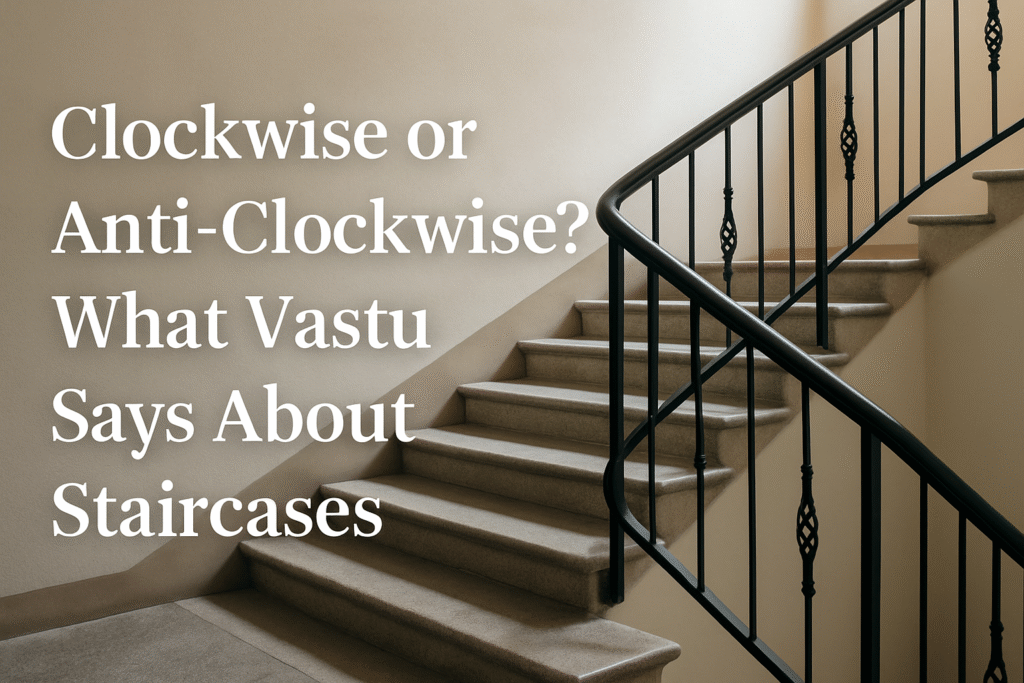
A staircase is just a way to move between floors, right?
Not in Vastu.
Because in the science of energy, how you rise matters just as much as where you go.
Many people ask:
“Should my stairs be clockwise or anti-clockwise according to Vastu?”
The answer isn’t one-size-fits-all. And more importantly — it’s not just about superstition. It’s about energy direction and life momentum.
Let me explain.
🔄 The Direction of the Staircase = The Direction of Your Energy
In Vastu, a clockwise staircase means that as you ascend, you turn toward the right.
An anti-clockwise staircase turns you to the left while going up.
Now here’s the insight that surprises most people:
- Clockwise = Downward energy flow
- Anti-clockwise = Upward energy flow
Think of it like loosening a screw — when you rotate it anti-clockwise, it rises.
The same principle applies to your own energy, growth, and opportunities.
🧭 Direction Matters: Where You Place Your Staircase Changes Everything
The direction in which the staircase turns should match the zone of the house it’s in.
For example:
- In the North (opportunity zone), anti-clockwise stairs are ideal — they lift energy upward, bringing more opportunities.
- In South-East (fire zone), clockwise stairs support grounding and digestion (both literal and emotional).
- In South-West (stability zone), clockwise movement brings restfulness and depth.
- In North-East (wisdom zone), anti-clockwise can support inner clarity and expansion.
💡 Moral? There is no universally “good” or “bad” staircase direction — it’s about matching the flow to the zone’s purpose.
💬 A Real Story: When Knowledge Saved a Costly Mistake
A client of my mentor was building a new factory and had chosen to place an anti-clockwise staircase in the North zone — a thoughtful decision to uplift financial flow and welcome fresh opportunities, as per Vastu principles.
But when a visiting architect saw the layout, he raised an alarm:
“Anti-clockwise stairs? That doesn’t seem right. You should change them before it affects the energy of the space!”
Naturally, the client became anxious. He trusted the Vastu design, but the architect’s concern made him second-guess the decision.
Instead of arguing, the Vastu consultant invited the architect to take a short walk.
They went upstairs together, stood at the top of the staircase, and the consultant asked:
“Just observe — from this level, which way do the stairs turn as we look down?”
“Clockwise,” the architect replied.
“Exactly,” said the consultant. “The energy rises from below and supports this level. That’s the alignment we were working with.”
The architect nodded. It suddenly made sense.
📌 Lesson? Vastu is not about rigid rules or fear-based decisions.
It’s about understanding energy movement — and using it consciously.
🧱 Final Thoughts: More Than Just Bricks and Turns
The staircase is one of the most powerful energetic tools in a home or building.
It can anchor growth, support emotional movement, and even affect your physical wellbeing.
✔️ When placed correctly: it lifts your life
❌ When misaligned: it can subtly pull you down, emotionally or materially
🏡 Wondering If Your Staircase Supports Your Growth?
Whether you live in a duplex, builder floor, or a high-rise apartment in Noida, your staircase plays a role in how your energy flows daily.
If you’d like to explore how the layout of your home or office might be supporting (or blocking) your goals, I’d be happy to guide you.
📍 Based in Supertech Capetown, Sector 74, Noida
📅 Book a Vastu session here
Let’s help you rise — one step, one turn, one zone at a time. 🌿